
What is a cloud storage server? A detailed explanation of the core concepts and functions
Time: 2026-10-14
Editor: USTAT.COM
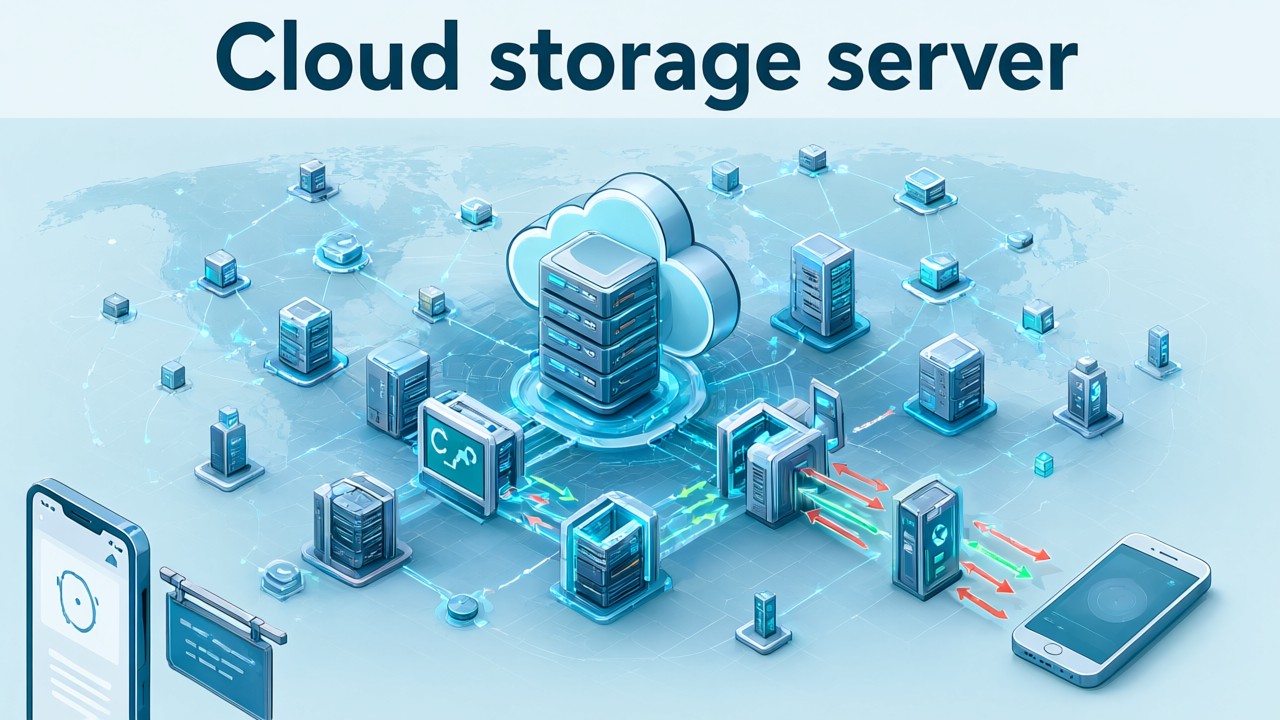
in today's digitalization wave sweeping all walks of life, data has become one of the most valuable assets of enterprises. Whether it is a large number of photos and documents of individual users, or a key business system in the operation of an enterprise, it is inseparable from a reliable data storage and access solution. Traditional local hard disks or single servers are facing challenges such as difficult capacity expansion, high hardware maintenance costs and high data security risks. It is against this background that a new network-based service model has emerged. It revolutionizes our understanding of data management by deploying storage resources centrally and providing them to users in the form of services. This article will deeply analyze the core concepts of this technology, sort out its development context, and focus on its underlying role and unique value as a modern IT infrastructure, to help readers establish a clear and comprehensive cognitive framework.
First, the basic definition of cloud storage server
understand the cloud storage server, it first needs to be disassembled into two parts: "cloud" and "server". The "cloud" here does not refer to the natural cloud, but refers to the computing model that provides dynamic, scalable and virtualized resources through the Internet. Therefore, the cloud storage server is not an isolated physical device, but a huge system composed of many storage nodes, network equipment and management software. It integrates the scattered storage resources into a logical whole through the network, providing a unified access interface to the outside world.
1, Core Architecture and Component
In terms of technical architecture, cloud storage servers usually contain a storage layer, a management layer, and an application interface layer. The storage layer is the physical foundation, composed of a large number of hard disks or solid state drives, which are organized through a distributed file system. The management layer is responsible for complex tasks such as data redundancy, load balancing, fault detection, etc., to ensure high data availability. The application interface layer provides users with convenient access methods, such as standard File Transfer Protocol, application programming interface, or graphical console.
2, the essential difference from ordinary servers
ordinary servers often correspond to a specific hardware device, and their storage capacity and computing power are limited by physical configuration. Cloud storage servers realize the decoupling of logical and physical resources. Users see unlimited storage space that can be purchased on demand, without caring about where the underlying hardware is located and how to maintain it. This elastic scaling and pay-as-you-go model is the most significant feature of cloud storage servers, and it is also the key to differentiating them from traditional self-built storage solutions.
2, the operation mechanism of cloud storage server
it is crucial to understand how cloud storage servers operate efficiently internally. Instead of simply stacking data on hard drives, it relies on a sophisticated set of distributed algorithms to ensure performance and security. When a user uploads a file, it is not stored in its entirety on a single node, but is intelligently split into multiple data blocks.
1, data slicing and distributed storage
these data blocks are distributed to different physical servers in the cluster according to a specific policy. The benefits of this approach are obvious: even if a hardware failure occurs on one server, copies of the data blocks stored on other servers can still be fully restored to the original file. At the same time, multiple requests can read data blocks on different servers in parallel, thus greatly improving the read and write speed and solving the problem of single server performance bottleneck.
2, data redundancy and disaster recovery mechanism
In order to deal with extreme situations such as hard disk damage, power failure in the computer room and even regional disasters, cloud storage servers generally use multi-copy or erasure code technology. The multi-copy mechanism is simple and intuitive, that is, multiple copies of the same data are stored in different racks or different data centers. The erasure code technology saves more space, calculates the verification data through mathematical algorithms, and can be rebuilt when some data is lost. These mechanisms together form a solid line of defense to ensure that data is not lost.
3, the core role of cloud storage server
cloud storage server plays an indispensable role in modern informatization construction, and its role has long gone beyond simple data storage. For enterprises, it is not only a tool to save hardware procurement costs, but also a cornerstone to promote business innovation and digital transformation. It allows enterprises to liberate limited energy from cumbersome infrastructure maintenance and focus on the development and optimization of core business logic.
1, achieve elastic scalability and cost optimization
traditional model, companies need to predict storage needs in the next few years and purchase equipment in advance, which often results in wasted or insufficient resources. Cloud storage servers provide true elasticity, allowing for instant expansion during peak periods and easy contraction during trough periods. Users pay only for the capacity and traffic actually used, turning fixed capital expenditures into variable operating expenses, which greatly optimizes the cash flow and IT cost structure of the enterprise.
2, empower big data and artificial intelligence applications
today's big data analytics and artificial intelligence model training rely on massive datasets. Cloud storage servers, with their massive capacity and high throughput, can easily handle petabytes of data storage requirements. At the same time, it is often tightly integrated with high-performance computing services, so that data does not need to be frequently migrated between storage and computing resources, which significantly shortens the cycle of data analytics, accelerates the iterative process of AI models, and allows data to be truly transformed into business insights.
3 Provide global access
for multinational enterprises or teams with teleworking needs, the distributed node layout of cloud storage servers is of great significance. Users can quickly access files stored in the cloud via the Internet anytime, anywhere. This global accessibility not only improves the efficiency of team collaboration, but also ensures that users in different regions can get a low-latency access experience, thus improving the overall service quality and user satisfaction.
Security and Challenges of Cloud Storage Server
Despite the significant advantages of cloud storage servers, security issues are always the focus of users' attention. Does hosting data to a third-party service provider mean giving up control over your own data? The answer is not absolute. Modern Cloud as a Service providers have invested huge resources in security, providing protection capabilities far beyond the average enterprise's own computer room.
1, multi-level security protection system
cloud storage servers are usually equipped with three-dimensional protection measures such as network firewalls, intrusion detection systems, data encryption transmission and static encryption. Service providers also conduct regular security audits and bug fixes. For users, it is more important to understand the "shared responsibility model", that is, the Cloud as a Service is responsible for the security of the infrastructure, and users are responsible for the access rights management of their own data, account security and application layer security configuration.
2, network dependency and migration costs
the use of cloud storage servers is highly dependent on a stable internet connection. In an environment where the network is disconnected or the network is not in good condition, data access will be affected. In addition, although Cloud as a Service provides convenient migration tools, if you want to migrate large amounts of data from one Cloud as a Service provider to another or back to the local area, you will still face considerable data transmission costs and time costs. Therefore, when choosing Cloud as a Service provider, enterprises need to fully consider the openness and compatibility of their technology ecosystem.
sum up, cloud storage server transforms storage into an on-demand elastic service through distributed architecture and virtualization technology. With its outstanding advantages in elastic expansion, cost control, high data availability, and empowering cutting-edge technologies, it has become an indispensable underlying support for digital operations in modern enterprises. Understanding its core concepts and operating mechanisms will help us plan data strategies more scientifically and use cloud resources more securely, so as to seize the opportunity in the data-driven future competition.